
GOOGLLITE
Gemini3: Pre-training Scaling Laws Continue to Deliver, RL May Bring Even Bigger Surprises Next, and We Remain Bullish on the Google TPU Supply Chain
FUNDA
Gemini 3 proves compute wins; Ironwood TPU scale-up to fuel OCS/BiDi orders for Lumentum and Innolight.
The long-awaited Gemini 3 finally launched yesterday, and the entire industry seemed to have been holding its breath for it. Based on the benchmarks released so far, the model largely meets the high expectations that had built up beforehand. It resets records across multiple mainstream leaderboards, especially in long-horizon reasoning, native multimodal alignment, and cross-modality inference. On many benchmarks the performance gap over competitors is not small, rekindling optimism that large models may genuinely break through long-chain task complexity and real-world application depth. These capabilities are precisely where the next stage of AI deployment will happen—far beyond simple chat or text generation.
What’s interesting is that Gemini 3’s improvement doesn’t come from fancy RL tricks or alignment methods, but almost entirely from stronger pre-training. Multiple sources, including Google employees, confirmed this point: this round of progress is, quite literally, “built on brute-force compute.”
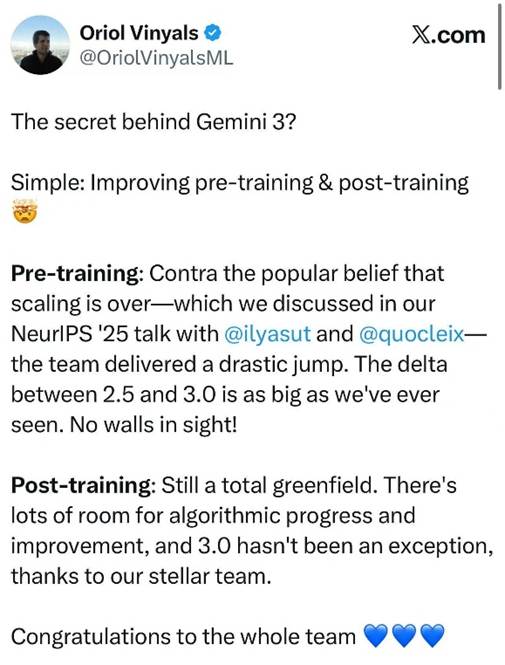
Google was able to achieve this because it possesses the industry’s most distinctive asset: extremely large-scale clusters of self-developed TPUs, paired with OCS (optical circuit switching) networks and BiDi optical transceivers tuned specifically for training. Under this architecture, TPU superpods can reach exceptionally high bandwidth utilization and maintain consistent, near-linear throughput even at massive parameter scales and data loads. Put simply: “more compute, better performance” and Google has more “compute” than anyone else.
Continue reading with FUNDA
This report is available to subscribers. Sign in or subscribe to read the full analysis.