
UAPPTTWORBLXGOOGLMETA
U&APP&TTWO&RBLX: Why Game Engine’s Role in World Models Is More Like the CPU’s Role in Agentic AI
FUNDA
AI world models won't replace engines; Unity/Roblox stand to gain as execution layers stay essential.
What the market is worried about: if AI can directly “generate worlds,” do we still need game engines?
After Google opened its world model Genie 3 to users, Unity’s share price saw a sharp sell-off. As of the close on January 30, 2026, the stock fell 24.22% in a single day to USD 29.10. Echoing the recent “AI kills software” narrative, the market quickly formed an intuitive conclusion: if AI can directly generate interactive worlds or games, will traditional game engines be displaced?
It is true that early demonstrations of Genie make ideas like “learning interaction from video” or even “generating playable environments” feel close at hand. The problem, however, is that this line of thinking conflates two very different questions. One is whether content can be generated at all. The other is whether that generated content can function as a long-lived, stable, and operable interactive system.
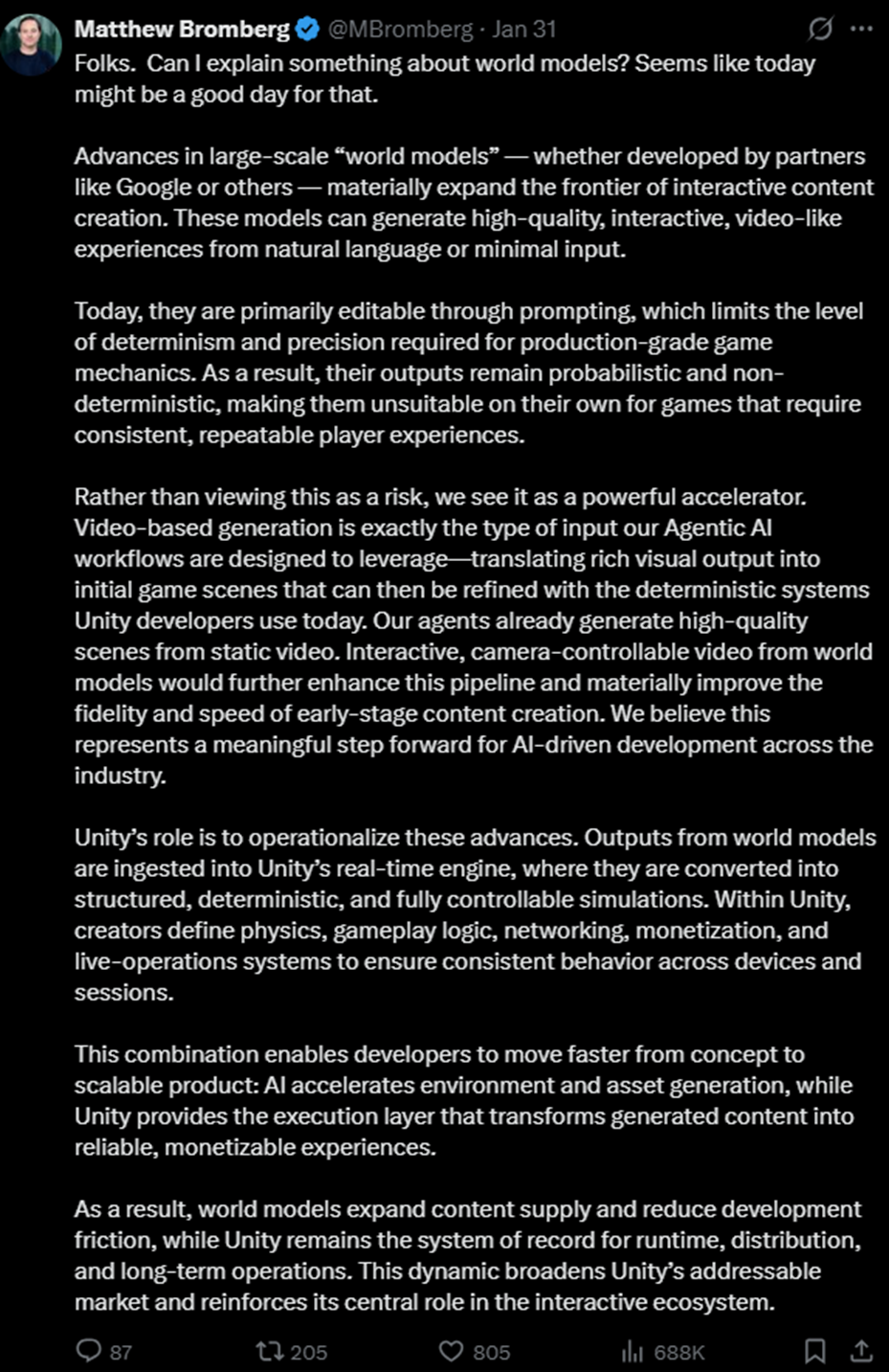
This distinction was precisely what Unity CEO Matthew Bromberg highlighted in his public response. World models can dramatically speed up content creation, but commercial-grade interactive experiences still depend on deterministic execution systems, not on probabilistic generative outputs. In our view, the current market panic stems less from fundamentals and more from a misunderstanding of the world-model landscape, combined with an underappreciation of Unity’s underlying engineering value.
Continue reading with FUNDA
This report is available to subscribers. Sign in or subscribe to read the full analysis.