
AAPLGOOGLSSNLFARM
Apple intelligence – ultimate winner in AI? – part 2
FUNDA
Apple vs. Android, Reasoning, Search, PCC, iPhone Sales, Regulations, Other Hardware, Semiconductor
In our previous article, we discuss Apple’s ambition to become the personalized assistant for everyone and the entry point of AI user traffic. In this article, we are continuing our discussion in Apple Intelligence.
Apple vs. Android
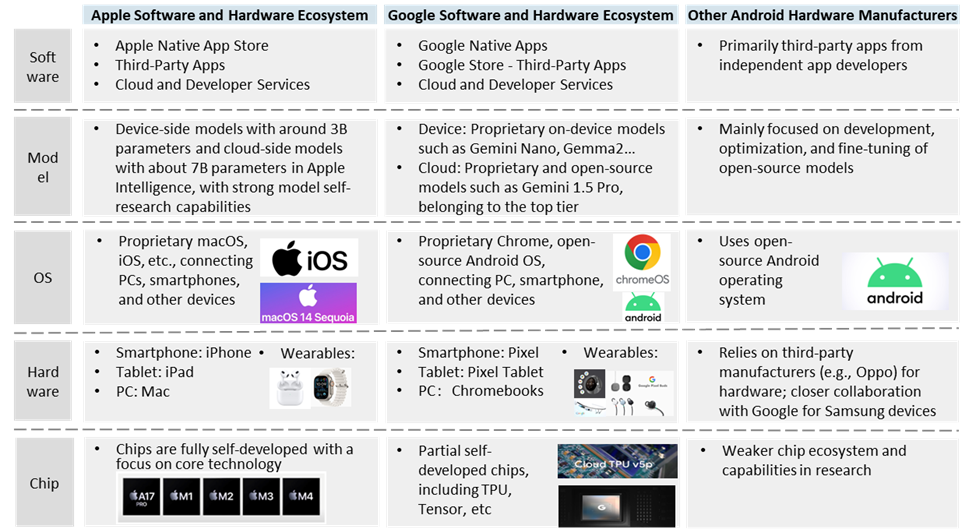
Apple and Google's ecosystems present unique competitive advantages. Apple has a complete ecological closed loop, while Google is also actively building its own ecosystem. For example, Google's latest self-developed chips and Pixel series devices are steadily developing towards AI entry points. Google recently released GPT-4-level Gemini Live. The Pixel 9 phone has actually made many upgrades, adding AI functions. This also reflects that model manufacturers in the Android ecosystem are working hard to find more scenarios and entry points to keep up with technological and ecological needs.
Figure 1. Ecosystem Comparison: Apple and Google, with integrated hardware, software, and proprietary AI, hold edge in on-device AI over third-party Android makers. Apple is “phone + AI” while Google is “AI + phone”
Google's two main projects currently are Project Astra, a voice agent, and an AI tool platform that allows models to call specialized tools according to specific needs, achieving personalized customization. This approach enables users to use AI models based on personalized needs, building a more complete AI ecosystem. Google recently reorganized the structure of the Android and Pixel teams to better promote the development of the AI hardware ecosystem.
Continue reading with FUNDA
This report is available to subscribers. Sign in or subscribe to read the full analysis.